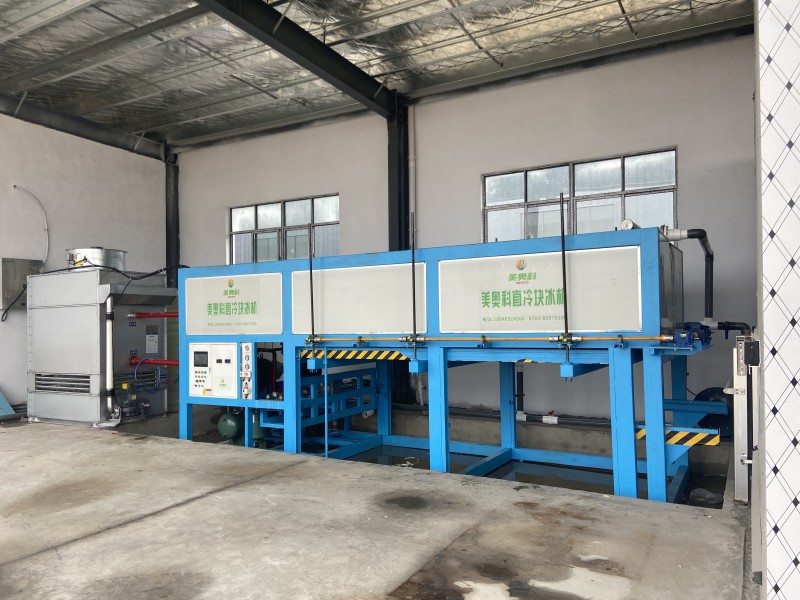
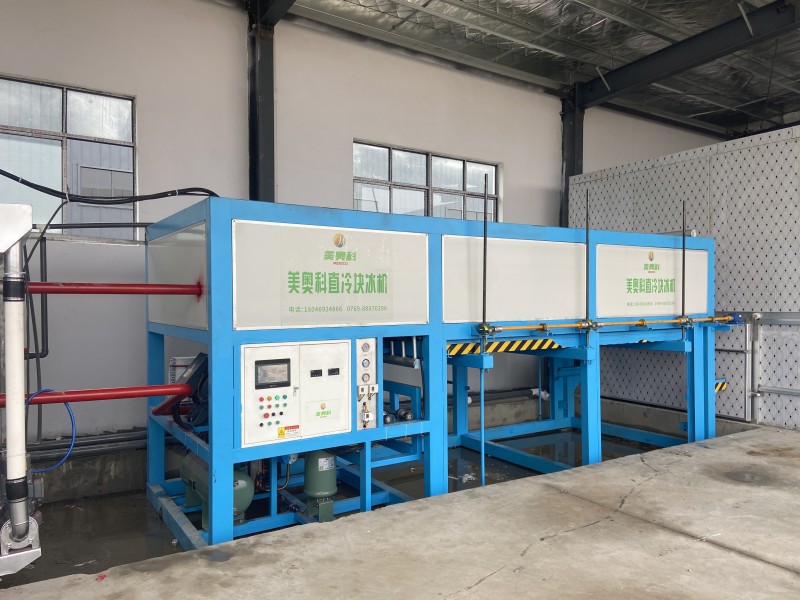
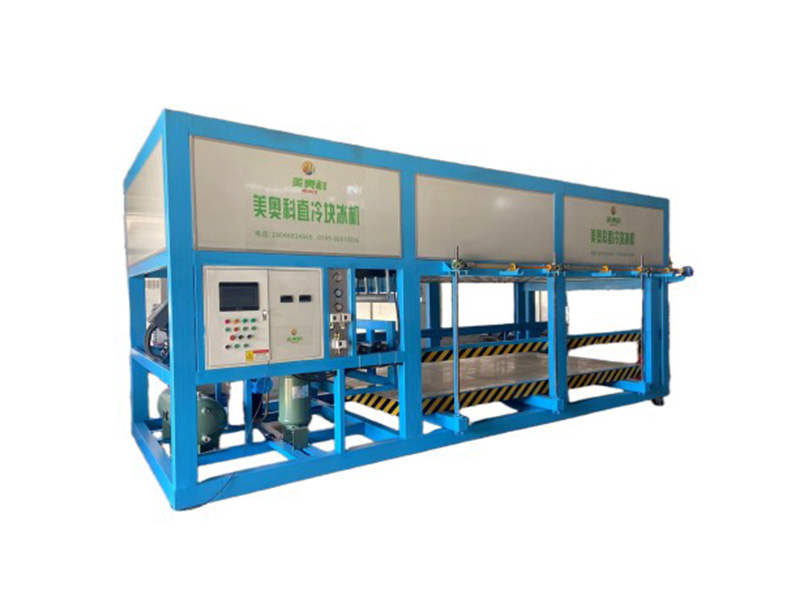
| Direct Cooling Block Ice Machine vs Brine Ice Machine - Comprehensive Comparison |
| Comparison Dimension |
Direct Cooling Block Ice Machine |
Brine Ice Machine |
Difference Description / Selection Tips |
| Refrigeration Principle |
Refrigerant directly enters the ice mold (aluminum mold/ice tray) for evaporative heat exchange, belonging to direct refrigeration with no intermediate secondary refrigerant |
Refrigerant first cools the brine, then low-temperature brine soaks the ice buckets to freeze ice, belonging to indirect refrigeration |
The brine system has an extra heat exchange step, and each heat exchange process brings temperature difference loss, which is the root cause of the gap in energy consumption and production capacity |
| Heat Exchange Path and Efficiency |
Cold energy → Ice mold → Ice, with short path and small temperature difference, leading to fast ice forming speed |
Cold energy → Brine → Ice bucket → Ice, with long path; the brine temperature usually needs to be maintained at -12℃ ~ -18℃ |
The direct cooling type has higher heat exchange efficiency, delivering more real production capacity under the same installed power; the brine system needs to maintain low-temperature brine for a long time, resulting in large cold loss |
| Ice Quality | With qualified water quality, it can produce transparent, dense and melt-resistant solid block ice with no salt stains on the ice surface | The ice body is prone to whitening or yellowing, with salt residue on the surface, and its hardness and melt resistance are relatively weak | The direct cooling type has obvious advantages in producing high-transparency solid ice and ice for long-distance transportation |
| Suitability for Edible Ice / Food-Grade Ice | Yes, the contact surfaces made of food-grade stainless steel and aluminum molds meet the requirements for food-grade ice (water quality needs to meet relevant standards separately) | Basically not applicable, due to high risks of brine leakage and salt residue; it is usually only used to produce industrial cooling ice | This is one of the most essential dividing lines between the two types of equipment |
| Ice Output Specification and Form | Replace the ice mold to adjust the weight of block ice (common specifications: 5kg/10kg/15kg/25kg/50kg, etc.), with flexible specification switching | Determined by the size of the ice bucket; changing specifications requires replacing all ice buckets, leading to high switching cost | For projects with multi-specification and small-batch orders, the direct cooling type is preferred |
| Ice Harvesting / Ice Discharging Method | Hot gas (hot fluorine) defrosting or ethylene glycol defrosting, with automatic ice falling and stable operation rhythm | Use a crane to lift the whole row of ice buckets into the ice melting pool, complete demolding by melting ice, then dump the ice and stack it | The ice discharging of brine machines relies on manual work and cranes, and the operation rhythm is affected by the proficiency of operators |
| Automation Level | Fully automatic: automatic water filling, ice making, ice harvesting, ice pushing and stacking (can be equipped with ice storage warehouse and conveying line), supporting unattended operation | Mainly semi-automatic: the ice making process is automated, but ice lifting, ice melting, ice dumping and stacking are mostly manual operations | The direct cooling type is closer to continuous production, while the brine type is more dependent on manual operation rhythm |
| Manpower Allocation (reference for 10-ton daily output) | About 1 person can take charge of 1~2 sets of units, mainly responsible for patrol inspection and auxiliary ice stacking | About 3~5 people (including crane operation, ice dumping, ice melting and stacking), with poor flexibility in staffing between peak and off seasons | Calculated based on local labor cost, the labor expenditure of brine machines is usually significantly higher |
| Power Consumption per Ton of Ice (empirical range) | About 45~60 kWh/ton of ice (affected by water temperature, ambient temperature and defrosting method) | About 60~85 kWh/ton of ice (including auxiliary energy consumption from brine pumps, stirring, ice melting, etc.) | The empirical value range is only for horizontal comparison; the actual data is subject to the specific configuration and working condition measurement; the power consumption of direct cooling type is generally 25%~35% lower than that of brine type |
| Civil Engineering Requirements |
No brine pool, ice melting pool or crane track is required; only flat hardened ground plus water, electricity and gas supply are needed, with simple foundation requirements |
It is necessary to excavate and build anti-seepage brine pools and ice melting pools, and install crane tracks and steel beams, leading to large civil engineering workload |
The civil engineering of brine projects usually accounts for a considerable proportion of the total investment, and cannot be reused after relocation |
| Floor Area |
Small footprint, modular layout, and can make use of existing factory buildings | Large footprint, occupied by the brine pool, ice melting pool and crane span | For areas with tight space and high rent, the direct cooling type is more cost-effective |
| Installation and Production Launch Cycle | The whole machine is factory commissioned; only on-site positioning, pipe connection and wiring are needed, and production can be started in 25 to 40 days usually | Civil engineering, pool curing, crane installation and brine deployment often take 1~3 months | The direct cooling type is preferred for projects that need to catch up with the schedule and seize the peak season |
| Equipment Corrosion Situation | No brine corrosion, the service life of aluminum molds and stainless steel contact surfaces is long, and only routine maintenance is required | Brine causes strong corrosion to ice buckets, evaporating pipes and crane steel structures, so ice buckets need regular replacement or major repair | The hidden maintenance cost of the brine system accumulates year by year |
| Consumables and Auxiliary Materials | Basically no continuous consumables, only routine maintenance parts such as refrigeration oil and filter elements | Continuous purchase of industrial salt is required, and the brine concentration (Baume degree) needs regular testing, supplement and adjustment | Salt consumption and brine management are long-term fixed expenditures for brine solutions |
| Daily Maintenance Workload | Low, the key work is condenser cleaning, water quality and defrosting valve inspection | High, it is necessary to monitor brine concentration and temperature, clean the pool, remove rust, and repair ice buckets and cranes | The difference in maintenance burden is obvious in factories with tight labor resources |
| Initial Investment Structure | The unit price of equipment is relatively high, but the investment in civil engineering and supporting facilities is low, making the overall solution cost controllable | The unit price of equipment is relatively low, but the investment in civil engineering, pools, cranes and steel structures is large | The overall investment including "equipment + civil engineering + supporting facilities + labor" should be compared, instead of only comparing equipment quotations |
| Capacity Expansion and Production Flexibility | Modular superposition of units, capacity can be increased on demand in batches without stopping production during expansion | The pool capacity and crane span are fixed, and capacity expansion requires modifying civil engineering, resulting in poor flexibility | The direct cooling type is preferred for projects with phased production and gradual capacity expansion |
| Relocation and Asset Flexibility | The whole machine can be disassembled and relocated, with high residual value when the factory building is changed or transferred | The pool and tracks are fixed on the civil engineering, and relocation is basically equivalent to scrapping | For projects in rented factory buildings or with uncertain planning, the direct cooling type is recommended |
| Environmental Protection and Safety | No brine leakage and waste brine discharge problems; the workshop is dry and tidy, with no hoisting risk from cranes | There are risks of brine leakage corroding the floor and waste brine disposal; the slippery environment and crane hoisting bring safety risks | In areas with strict environmental supervision, brine pools are key hidden danger points |
| Summary of Applicable Scenarios | Ice for food/aquatic product preservation, ice for supermarket and cold chain distribution, new small and medium-sized ice factories, ice for mixing station and engineering cooling, foreign trade export projects, phased production in rented factory buildings | Ultra-large established industrial ice factories, projects that only produce industrial cooling ice, renovation projects with limited budget and existing brine pools and cranes | Neither of the two routes has absolute advantages or disadvantages; the choice depends on ice quality requirements, site conditions and labor cost structure |
| Comprehensive Conclusion | For projects with long-term operation requirements, high ice quality requirements, pursuit of low labor and low operating costs, and limited site space, the direct cooling block ice machine is preferred; its comprehensive holding cost is usually better | The low unit price of brine ice machines is competitive only under the conditions of "ultra-large centralized production capacity + pure industrial ice production + existing civil engineering" | It is recommended to calculate the comprehensive cost per ton of ice by including electricity fee, labor cost, salt consumption, maintenance and civil engineering investment based on a 3~5-year holding cycle before making decisions |


 中文站
 English